How Many Potatoes Is 750 Grams? A Simple Kitchen Guide
How Many Potatoes Is 750 Grams? A Simple Kitchen GuideYou are halfway through a recipe when you notice the ingredient list asks for 750 grams of potatoes. You look at the potatoes on your counter and wonder: how many potatoes is 750 grams? The practical answer is roughly four to five medium potatoes, although the exact number depends on how much each potato weighs.
If your potatoes weigh about 150 grams each, five will give you 750 grams. If they weigh closer to 200 grams each, you will need three whole potatoes and most of a fourth. Two very large potatoes could also come close.
That is why potato counts should be treated as estimates. A kitchen scale gives the most reliable measurement, but you can still make a sensible estimate without one.
This guide explains how potato size affects the answer, how to measure a 750-gram portion, and what changes when a recipe calls for peeled, chopped, or cooked potatoes.
How Many Potatoes Is 750 Grams? The Quick Answer
750 grams is approximately four to five medium potatoes, using an illustrative medium-potato weight of 150–200 grams. Smaller potatoes require a higher count, while larger potatoes require fewer.
For a quick kitchen estimate, think of five potatoes weighing 150 grams each:
Alternatively, four potatoes averaging 187.5 grams each would also total 750 grams. Real potatoes rarely match an average perfectly, so a small final adjustment may be necessary.
If you are making a flexible dish such as soup or a tray of roasted vegetables, this estimate can help you get started. If the potato weight controls the balance of a dough, filling, or carefully tested recipe, weigh the prepared potatoes.
The useful takeaway is simple: begin with four or five medium potatoes, then check their combined weight whenever possible.
Why There Is No Exact Number of Potatoes
A gram measures weight, while a potato is an individual vegetable. There is no fixed relationship between the two because potatoes grow in different sizes and shapes.
Even potatoes from the same bag can vary noticeably. One may be short and round, another long and narrow, and another much heavier than it first appears.
Size descriptions also vary. What one shopper calls a medium potato might be considered small beside a large baking potato.
Official reference portions illustrate this difference. The FDA vegetable chart lists a medium potato as 148 grams. A Health Canada raw-potato entry lists a medium portion as 213 grams.
Neither reference tells you the exact weight of the potato in your hand. They explain why different guides can provide different counts while using the same word, “medium.”
Whenever accuracy matters, the actual weight is more useful than the size label.
A Practical Potato Weight Conversion Table
The table below uses example individual weights to show how the calculation works. These are convenient kitchen assumptions, not universal grading standards for potato sizes.
| Example Potato Description | Assumed Weight Each | Equivalent Needed for 750 Grams |
|---|---|---|
| Very small potato | 50 grams | 15 potatoes |
| Small potato | 75 grams | 10 potatoes |
| Smaller everyday potato | 100 grams | 7.5 potatoes |
| Medium potato example | 150 grams | 5 potatoes |
| Larger medium potato example | 200 grams | 3.75 potatoes |
| Large potato example | 250 grams | 3 potatoes |
| Very large potato example | 375 grams | 2 potatoes |
Fractions indicate a weight equivalent. You can cut part of a potato to reach the target rather than rounding automatically to another whole potato.
How to Calculate the Number Yourself
You only need one formula:
Estimated number of potatoes = Required total weight ÷ Average weight per potato
If the potatoes you usually buy weigh approximately 125 grams each:
750 ÷ 125 = 6 potatoes
If they average 250 grams each:
750 ÷ 250 = 3 potatoes
The calculation becomes more useful when the average comes from your own potatoes. Weigh several together, divide by the number weighed, and use that result as your average.
For example, if four potatoes weigh 640 grams, their average is 160 grams. Dividing 750 by 160 gives approximately 4.69 potatoes.
In practice, you would begin with four, add part of another, and stop when the total reaches 750 grams. The formula gives a starting point; the final weighing confirms it.
How Many Medium Potatoes Make 750 Grams?
For everyday cooking, four to five medium potatoes is a useful starting estimate. The important detail is what “medium” means in your kitchen.
Five potatoes weighing 150 grams each make exactly 750 grams. Four potatoes weighing 200 grams each make 800 grams, so you would remove about 50 grams to reach the recipe amount.
Using the 213-gram reference portion mentioned earlier, 750 grams is approximately three and a half reference portions. This helps explain why some guides suggest fewer potatoes.
Rather than worrying about which description is correct, look at the potatoes you have. A bag of compact everyday potatoes may require five. Bigger potatoes may bring the count closer to four or below.
If you regularly cook the same recipe, weighing your usual potatoes once can make future estimates much easier.
How Many Small or Baby Potatoes Make 750 Grams?
Small potatoes can vary even more in count because “baby potato” describes a broad group rather than one fixed weight.
If each potato weighs 50 grams, you need 15. At 30 grams each, you need 25. At 75 grams each, you need 10.
These examples show why saying “a handful of baby potatoes” does not provide a dependable conversion. Hand size and potato size both affect the result.
For a more useful estimate, check the package weight. If a sealed bag contains 750 grams, its entire contents provide the required purchased weight, before any trimming.
If the bag contains one kilogram, three-quarters of its contents is approximately 750 grams. Divide the potatoes by weight if possible, or make four visually similar groups and use three.
Visual grouping is only approximate, especially when the bag contains mixed sizes.
How Many Large Potatoes Make 750 Grams?
Three potatoes weighing 250 grams each total 750 grams. Two potatoes weighing 375 grams each also total 750 grams.
This means that two to three large potatoes can be a reasonable starting point, depending on how large they actually are.
Baking potatoes are a good example of why counting can mislead. A large, elongated potato may look similar in length to another while being much thicker and heavier.
If you are buying loose potatoes, select a few and check their combined weight on the store scale. You can then add a smaller potato or exchange one large potato to get closer to the target.
For recipes involving chopped potatoes, there is no need to find a perfect combination of whole vegetables. Cut the amount you need and keep the remainder for another use.
What Does 750 Grams of Potatoes Look Like?
A 750-gram portion might look like five moderate-sized potatoes, three substantial potatoes, or a bowl containing many smaller ones.
However, bowls, plates, and hands are poor measuring standards. A wide shallow bowl spreads potatoes out, while a narrow bowl makes the same quantity look larger.
You can create a useful personal reference by weighing 750 grams once and photographing the potatoes beside an object you regularly use.
This will not turn visual estimation into an exact measurement, but it can help with flexible recipes and shopping decisions.
Another option is to remember a familiar package. If you often buy a one-kilogram bag, 750 grams represents three-quarters of that weight.
Use appearance as a practical guide rather than proof. A quick scale check remains the easiest way to confirm your estimate.
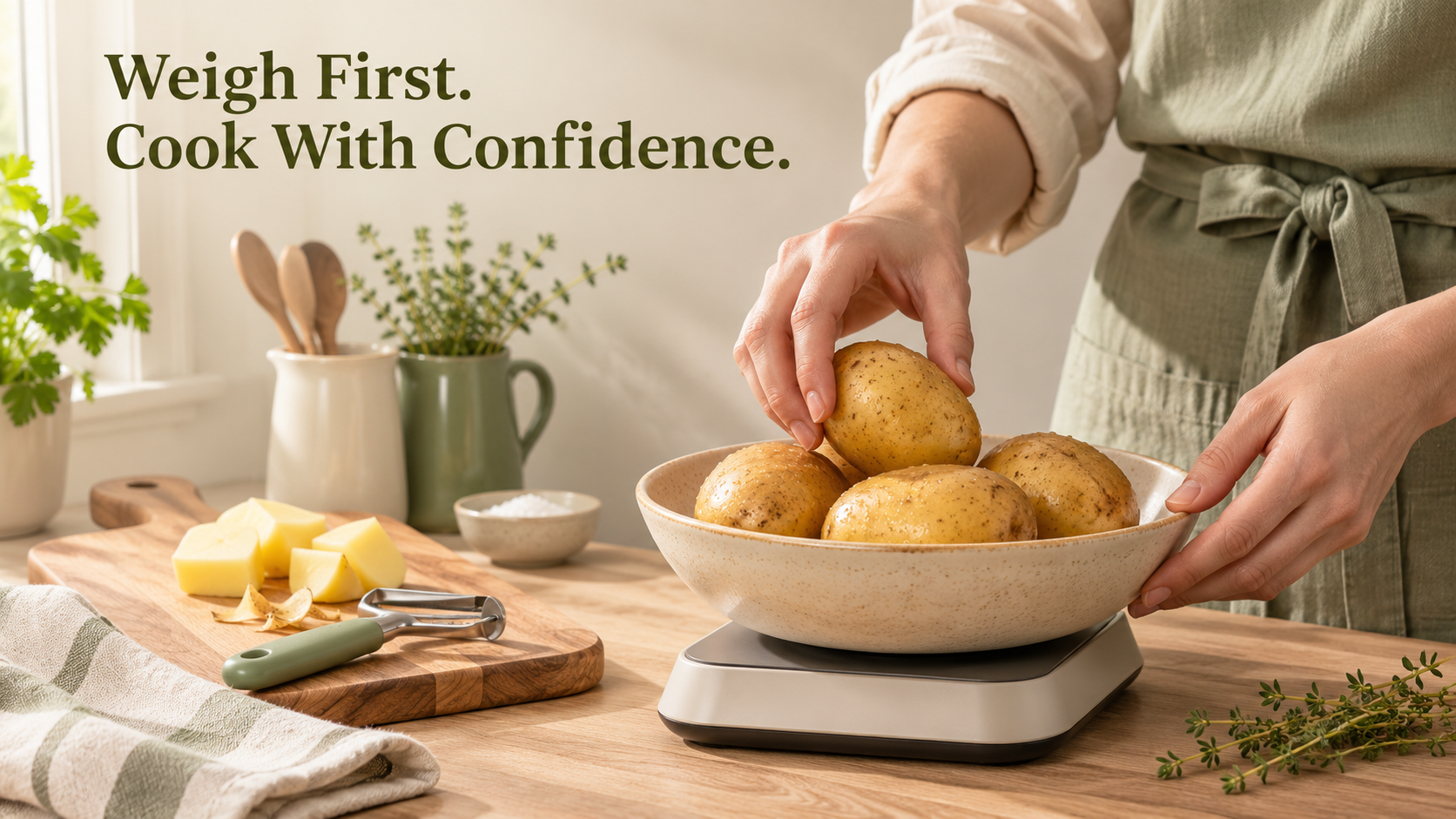
How to Measure 750 Grams With a Kitchen Scale
A digital kitchen scale removes most of the uncertainty.
- Place the scale on a stable, level surface.
- Select grams as the measurement unit.
- Put an empty bowl on the scale.
- Press the tare or zero button.
- Add potatoes until the display reaches 750 grams.
The tare function excludes the bowl’s weight. Without it, a heavy bowl could account for a large part of the displayed total.
Prepare the potatoes according to the recipe before weighing when the specified weight refers to the prepared ingredient. For example, weigh peeled potatoes after peeling if that is what the recipe requires.
If you overshoot, remove one potato and add smaller pieces until you reach the target.
Keep the scale display visible and make sure the bowl is not touching another object, which could interfere with the measurement.
How to Estimate 750 Grams Without a Scale
If a scale is unavailable, use the best information you have rather than relying entirely on appearance.
A package with a stated weight is especially useful. For example, half of a 1.5-kilogram bag equals 750 grams by weight.
You can divide the contents into two similar groups, matching larger potatoes with smaller ones. This is still an estimate because the groups may not weigh exactly the same.
Another approach is to use a known individual weight. If you previously weighed potatoes from the same batch and found an average near 150 grams, begin with five.
For a forgiving recipe, a close estimate may be sufficient. For a precise recipe, borrowing a scale or using a store scale is more dependable than converting several uncertain visual estimates.
Avoid assuming that every potato sold under the same variety name weighs the same.
750 Grams of Potatoes in Kilograms, Pounds, and Ounces
Weight conversions are useful when a recipe and your scale use different units.
| Unit | Equivalent of 750 Grams |
|---|---|
| Kilograms | 0.75 kilograms |
| Pounds | Approximately 1.65 pounds |
| Ounces | Approximately 26.46 ounces |
| Pounds and ounces | Approximately 1 pound and 10.5 ounces |
The kilogram conversion is exact: 750 grams is three-quarters of a kilogram. The pound and ounce figures above are rounded for convenient use.
Be careful with decimal pounds. A reading of 1.65 pounds does not mean one pound and 6.5 ounces. The decimal portion must be converted using 16 ounces per pound.
If your scale supports grams, selecting that unit is simpler than converting the target and introducing extra rounding.
Does 750 Grams Mean Peeled or Unpeeled Potatoes?
The recipe wording should guide you.
“750 grams of potatoes, peeled and chopped” commonly indicates that you measure the potatoes before completing the listed preparation. “750 grams of peeled potatoes” points toward weighing the prepared ingredient.
Writers do not always use these conventions consistently. Look for preparation notes, photos, or instructions that clarify the intended measurement.
If the recipe is flexible, a small difference may have little practical effect. If potato weight controls a sensitive ratio, follow the recipe’s stated method or seek clarification.
Peeling and trimming reduce the usable quantity. The amount removed depends on the tool, potato shape, skin condition, and how deeply you peel.
For a dependable 750-gram prepared portion, peel and trim enough potatoes, then weigh the usable pieces. This avoids guessing how much weight the preparation will remove.
How Much Extra Should You Buy for Peeling?
There is no single peeling allowance that works for every batch. Thin peeling removes less than thick peeling, and damaged potatoes may require additional trimming.
You can calculate the required purchased weight if you know your usable yield.
Purchased weight = Required prepared weight ÷ Usable yield
For a hypothetical 90% usable yield:
750 ÷ 0.90 = approximately 833 grams
For a hypothetical 85% usable yield:
750 ÷ 0.85 = approximately 882 grams
These percentages are calculation examples, not guaranteed peeling-loss rates.
If you do not know your yield, buying somewhat more than the final prepared amount gives you room to adjust. A one-kilogram bag may be convenient, with the unused portion available for another meal.
When keeping the skins, preparation losses may be smaller, but weigh after any trimming required by the recipe.
Does Chopping Change the Weight of Potatoes?
Cutting a potato into cubes, wedges, or slices does not by itself change its weight. The same potato remains the same amount of food after cutting.
Small differences arise when you remove peel, trim pieces, leave fragments on the board, or add water that remains on the surface.
For example, 750 grams of clean potatoes should remain approximately 750 grams after dicing if you retain all the pieces and do not add other ingredients.
Chopping does change how potatoes fit into a measuring cup. Small cubes may pack differently from large wedges, even when their combined weight is identical.
This is why a cup measurement should not be substituted casually for a gram measurement.
For recipes that specify weight, finish the requested preparation and check the amount at the appropriate stage. Keep the pieces reasonably uniform for more consistent cooking.
How Many Cups Is 750 Grams of Potatoes?
There is no universal cup conversion for potatoes. The result depends on whether they are diced, sliced, shredded, cooked, or mashed, as well as how tightly they are packed.
For one specific reference, Health Canada lists 250 milliliters of raw diced potato as 158.5 grams. Using that entry:
750 ÷ 158.5 = approximately 4.73 portions of 250 milliliters
That gives a rough volume estimate of about 1.18 liters for that particular diced-potato reference.
It should not be treated as a guaranteed conversion for your own chopped potatoes. Different cube sizes and packing arrangements can change the weight in the cup.
Cup sizes also differ between measurement systems. A 250-milliliter metric cup is not exactly the same as a U.S. customary cup.
Whenever possible, use the original weight rather than converting through volume.
Is 750 Grams of Raw Potatoes the Same as Cooked Potatoes?
No. A 750-gram raw portion should not automatically be substituted for a 750-gram cooked portion.
Cooking can change water content, and some methods add ingredients that contribute weight. Roasting allows moisture to escape. Boiling, draining, and cooling produce a different result. Mashing with milk or butter changes the total again.
There is no single raw-to-cooked conversion that works for every preparation.
If a recipe asks for 750 grams of raw potatoes, measure before cooking at the preparation stage it specifies. If it asks for 750 grams of cooked potatoes, weigh the cooked, drained ingredient.
For repeated meal preparation, record your own batch. Weigh it before and after cooking under the same conditions. Your measured result will be more useful than an assumed yield taken from a different cooking method.
How Many People Will 750 Grams of Potatoes Serve?
Serving count depends on appetite, the rest of the meal, and whether potatoes are a main ingredient or a side dish.
A simple planning calculation uses a chosen raw-potato allowance per person:
| Assumed Raw Amount Per Person | Portions From 750 Grams |
|---|---|
| 125 grams | 6 portions |
| 150 grams | 5 portions |
| 187.5 grams | 4 portions |
| 250 grams | 3 portions |
These are meal-planning examples, not prescribed serving recommendations.
As a practical starting point, 750 grams can provide several side portions, with three to five portions depending on how generously you serve.
For a meal with rice, bread, vegetables, and another main dish, you may choose smaller potato portions. A potato-centered meal may call for more.
Using 750 Grams of Potatoes for Mashed Potatoes
Mashed potatoes are a good example of why the preparation stage matters.
If your recipe calls for 750 grams of peeled potatoes, prepare the potatoes and weigh them before boiling. If it specifies unpeeled weight, follow that instruction instead.
Cut the pieces to similar sizes so they cook more evenly. Once cooked, drain according to the recipe before adding the remaining ingredients.
The finished mash will not necessarily weigh 750 grams. Cooking changes moisture, while milk, butter, cream, or other additions contribute their own weight.
If you are dividing the finished dish into equal servings, weigh the complete mash and divide by the number of portions you want.
Do not use the original raw weight as though it were the final dish weight. Keeping those two measurements separate makes recipe scaling and portioning much clearer.
Using 750 Grams for Roast Potatoes or Fries
For roasted potatoes, begin with the weight stated in the recipe and prepare the pieces as directed.
Whether you use wedges, chunks, or smaller whole potatoes, consistent size helps the pieces cook at a similar rate. The number of whole potatoes becomes less important after cutting.
Tray space also matters. A 750-gram batch spread across a suitable tray behaves differently from the same batch crowded into a small dish.
For fries, the purchased potato weight is different from the finished cooked weight. Peeling, trimming, moisture changes, and added oil affect the result.
If you are following a recipe, measure the potatoes at its specified stage and keep the other ingredient quantities proportional.
If you are simply cooking a side dish, a reasonable estimate can be enough. Check the batch itself rather than assuming five potatoes always behave like the five used last time.
Using 750 Grams in Potato Salad, Soup, or Curry
Potatoes appear in many dishes where a small weight difference can be manageable, but the recipe context still matters.
For potato salad, check whether the listed amount refers to raw or cooked potatoes. Dressing and other ingredients increase the final dish weight.
For soup, adding more potato can change how much liquid you need and how thick the finished dish becomes. Begin with the recipe quantity, then adjust deliberately.
For curry, potato size and cut affect the balance between potato pieces and sauce. Large chunks and small cubes do not create the same eating experience even at equal weight.
These dishes usually do not require identical whole-potato counts. Aim for the specified weight and reasonably consistent pieces.
Record any changes you enjoy so that the next batch can be repeated without starting from a new guess.
Does Potato Variety Change the Count?
Variety names alone do not provide a reliable grams-to-potatoes conversion.
Potatoes sold as russet, red, yellow, or white can still vary considerably in individual weight. Growing conditions and the sizes selected for a package also affect what you buy.
Some packages contain relatively uniform potatoes, while others contain a mixture of small and large ones. A uniform batch is easier to estimate by count, but weighing remains more reliable.
Choose the type recommended for your recipe, then measure the quantity separately.
If you replace one variety with another, do not assume that the same number of whole potatoes gives the same weight. Five smaller potatoes may weigh less than three large ones.
The useful rule is to let the recipe guide your choice of potato and let the scale guide the amount.
How to Scale a Recipe to 750 Grams
If a recipe uses a different potato weight, calculate a scaling factor.
Scaling factor = Desired potato weight ÷ Original potato weight
To reduce a recipe from one kilogram of potatoes to 750 grams:
750 ÷ 1,000 = 0.75
Multiply the other ingredient quantities by 0.75. For example, 200 milliliters of milk becomes 150 milliliters, and 40 grams of butter becomes 30 grams.
To increase a recipe from 500 grams to 750 grams:
750 ÷ 500 = 1.5
Multiply its ingredient quantities by 1.5.
Cooking time does not necessarily scale by the same factor. Piece size, pan size, depth, and cooking method affect timing.
Use the scaled ingredients as your starting point, then follow the recipe’s doneness cues rather than multiplying every instruction mechanically.
A Worked Example With Mixed Potato Sizes
Suppose you have a bowl of mixed potatoes and need exactly 750 grams of prepared pieces.
After washing and completing the required trimming, you weigh four potatoes:
- First potato: 180 grams.
- Second potato: 165 grams.
- Third potato: 210 grams.
- Fourth potato: 155 grams.
The total is:
180 + 165 + 210 + 155 = 710 grams
You need another 40 grams. Cut a piece from an additional potato, place it in the bowl, and adjust until the total reaches 750 grams.
Your final quantity is four whole prepared potatoes plus a piece of another.
This example explains why “four or five potatoes” is useful for planning but cannot guarantee a recipe weight. The actual combination is what matters.
Common Mistakes When Measuring Potatoes
A few small measuring habits can create surprisingly large differences.
- Treating every medium potato as identical: Size labels are approximate.
- Forgetting to tare the bowl: Container weight should not count as potato weight.
- Mixing raw and cooked measurements: Weigh at the stage the recipe specifies.
- Ignoring peel and trimming: Purchased weight may exceed usable weight.
- Using an unrelated cup conversion: Diced, sliced, and mashed potatoes pack differently.
- Confusing decimal pounds with ounces: The units require a proper conversion.
Another mistake is rounding a fractional potato upward without considering the difference. If the calculation suggests 3.75 potatoes, four whole potatoes may exceed the target.
For flexible cooking, that difference may be acceptable. For a precise recipe, cut and weigh the final portion instead.
Frequently Asked Questions
How many potatoes is 750 grams exactly?
There is no exact whole-potato count. Five potatoes weighing 150 grams each equal 750 grams, but potatoes vary. Weigh the actual potatoes for an exact result.
Is 750 grams about five potatoes?
Yes, if each potato averages approximately 150 grams. Five much larger potatoes would exceed the target, while five smaller potatoes could fall short.
Can three potatoes weigh 750 grams?
Yes. Three potatoes averaging 250 grams each weigh 750 grams. Check their combined weight rather than relying only on the word “large.”
Is 750 grams less than one kilogram?
Yes. It is 0.75 kilograms, or three-quarters of a kilogram. You would need another 250 grams to reach one kilogram.
Can I use a measuring jug?
A jug measures volume. It cannot directly establish potato weight unless you use a suitable, clearly qualified conversion. A kitchen scale is more dependable.
Should I weigh potatoes after washing?
You can weigh clean potatoes, but remove excess surface water. Follow the recipe’s instructions about peeling and trimming so the measurement matches the intended ingredient.
Do I need exactly 750 grams for every recipe?
That depends on the dish. Flexible soups or vegetable trays may tolerate an estimate. Recipes with sensitive ingredient ratios benefit from accurate weighing.
What is the easiest way to remember the amount?
Remember five potatoes at 150 grams each as a starting estimate. Then adjust for the actual size of your potatoes and weigh whenever precision matters.
The Practical Answer for Your Next Recipe
If you are wondering how many potatoes is 750 grams, start with approximately four to five medium potatoes. Five 150-gram potatoes, three 250-gram potatoes, or two 375-gram potatoes all reach the same total.
The count is useful for shopping and getting ingredients ready. The weight is what confirms the amount.
Check whether your recipe means raw, peeled, or cooked potatoes, measure at the correct stage, and use the tare function when weighing in a bowl. These simple habits make the result easier to repeat.
Without a scale, use package weights and clearly stated assumptions. With a scale, you can stop guessing and measure the 750 grams your recipe actually needs.